|
||||||
|
Decide for yourself if the Shroud of Turin is real |
||||||
|
||||||
|
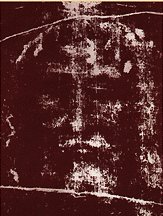
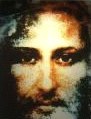
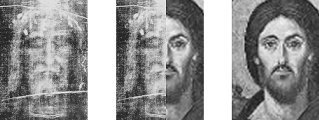
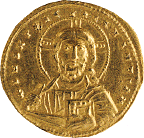
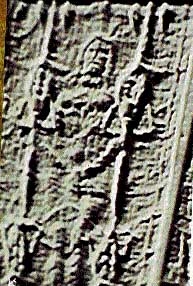
Until 1204 CE, when crusaders sacked Constantinople, there was in that city, a picture of Jesus on a piece of cloth. It had been moved there from the city of Edessa in 944 where it was discovered in the city walls in 544. Historians think that the Edessa Cloth, also known as the Mandylion, is what we now call the Shroud of Turin. Bible Probe Question? Did it Happen in a "Divine Radiant Flash" during the resurrection? The
image is actually a 3-D encoded chart of the front and back of a man
that also happens to have the important characteristics of a
photographic negative. This unique dual quality may help theoretical
physicists understand how the image was created. Pollen and flower fragments; wood cells Max Frei, a Swiss criminologist examined the Shroud fibers between 1973 and 1983, and identified 58 types of pollen from plant species on the shroud from Jerusalem, Turkey, France and Italy. Some of the flower fragments point to flowers blossoming in the Jerusalem area in March-April. Jesus' crucifixion date is believed to be April 6, 30 AD. More recently tiny wood cells from the scalp area have been identified with Oak (commonly used wood for Crucifixion).. Scientific tests The 1978 study of the Shroud revealed the image was not a painting or the result of vapor action. The outermost fibrils of the cloth on the body side show the light yellow-brown color. The fibers appear to have been discolored by dehydration and oxidation of the topmost fibers closer to the body, resembling but not identical to a scorch image. The intensity of the discoloration varies in inverse proportion to the distance from the body. If some type of radiation was the source, it appears to have acted perpendicular to the body surface. The image has no distortion. The cloth had to be stretched flat to produce this effect! Furthermore, the hair appears to be flowing down as if the body were vertical. There is some indication of something like x-radiation producing image of the bone structure of the teeth and other areas. No one really knows for sure what types of radiation were involved in the image formation. Reddish stains near the wound marks have been confirmed to be due to human blood. An AB type male blood has been identified (common in northern Palestine). DNA analysis has been possible but only about 350 of the three billion base pairs have been left in the blood fragments. Archaeological evidence In 1968 a skeleton of a Jewish male belonging to the time AD 70 was excavated from the area near Jerusalem. There was a 7 inch (18 cm) long nail found pinned to the feet. The wrists had pierced marks. The Shroud image indicates the nails were struck through the wrists, not through the palms of the hand as popularly shown (one medical doctor recently has questioned Barbet's 1931 theory of nailing through the wrists, and suggests that the nail went obliquely from the thumb side of the palm to the lower back of the palm). The Risen Christ told doubting Thomas, “See my hands” (Jn 20:27). The Jewish “hand” includes the wrist and lower forearm; when Jews ritually wash their hands they include these. The Greek word usually translated as “hands” also includes the wrist and lower forearm. Artists depicting the crucifixion from that time through the medieval period invariably placed the wounds in Jesus’ palms; Bolognese artists of the 16th century were the first to recognize that using the palms was anatomically impossible. Dr. Pierre Barbet’s experiments showed that nailed hands will not support the weight of a man. Many stigmatists have experienced their wounds in the palms, but the varied locations and depths of the stigmata are clear evidence that God gives the stigmata for their mystical value, not as literal replicas of Christ’s wounds. However, Dr. Barbet discovered that a nail driven into the fold of the wrist easily enters into an area called the Space of Destot. The wrist wounds in the Shroud image are consistent with these findings. A nail driven into the Space of Destot would not fracture any of the carpal bones. God had commanded of the paschal lamb, “You shall not break a bone of it” (Ex 12:46). Again God commanded, “nor break a bone of it ?” (Num 9:12). King David prophesied of the Messiah, “He keeps all his bones; not one of them is broken“ (Ps 34:20). John told us, “When they came to Jesus and saw that He was already dead, they did not break His legs” (Jn 19:33). However, the nail would damage the median nerve, which would immediately pull the thumb under the palm. The Shroud image has no visible thumbs. Crucifixion was designed to produce slow torture leading to death. Left alone on the cross, most victims could last several days. So, when the Roman soldiers were ready to leave, they would break the legs of their victims to bring asphyxia and death within a few minutes. Jesus, exhausted by His ordeal, died after three hours. “But one of the soldiers pierced his side with a spear, and at once there came out blood and water” (Jn 19:34). The Man of the Shroud had on His right side, between the fifth and sixth ribs, an elliptical wound 13/4 inches long and just less than half an inch wide, the exact dimensions of excavated Roman lances. That wound area shows a visible separation of blood and a clear liquid. There is too much clear liquid for it to be entirely serum. Some researchers think the clear fluid came from the pericardial sac, others from the pleural sac, and still others from the pleural spaces surrounding the lungs. All agree that the blood and clear fluid came from a puncture wound that pierced the Man of the Shroud’s heart after He died.
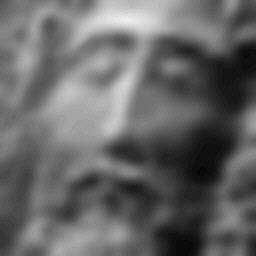
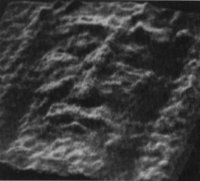
Image magnification and enhancement With the aid of a VP-8 Image analyzer, Sandia Laboratory scientists John Jackson and Eric Jumper were able to show that the Shroud image has three dimensional features unlike a photographic image. The 3-D reconstruction of the body is shown below. The manufacturer of the VP-8 Analyzer who watched it had a life changing experience!
|
||||||
| The Shroud of Turin is
consistent with Jewish burial customs of Jesus’ time. The standard
measure was the cubit, originally the distance from elbow to
fingertips but by then standardized at 21.7 inches. The Shroud was
woven to cubit measure, eight cubits long and two cubits wide. In
English measure it is about 14 feet 3 inches long by 3 feet 7 inches
wide.
During the first century one of every eight Egyptian residents was Jewish. In Alexandria more than half the population was Jewish. Consequently, many Jews were buried according to Egyptian customs. The ancient Egyptians believed that the deceased could take worldly possessions with them into the world to come; consequently they were buried with gold, silver, or precious stones in shrouds sewn with golden threads. Wherever the Christian Gospel is proclaimed demonic activity increases. When Jesus arrived on earth there was a whirlwind of demonic activity. In the entire Old Testament there is not even one exorcism, yet Mark’s Gospel records many exorcisms. One result of all this demonic disturbance was that many Romans began pillaging graves for gold. Since tampering with the body is abhorrent to Jews, the rabbis responded by emphasizing simple burial procedures that would remove the financial incentive for desecration. The tachrichim, wrappings, were to be of inexpensive white linen without pockets. Matthew says Jesus’ body was wrapped “in a clean linen shroud” (Mt 27:59). Mark says Joseph of Arimathea; bought “a linen shroud” (Mk 15:46). Luke says Joseph “wrapped [Jesus] in a linen shroud” (Lk 23:53). John, however, says that they “bound [Jesus’ body] in linen cloths” (Jn 19:40). In Greek, the three synoptics use the word sindon, or shroud, but John uses othonia, which indicates the linen cloths used in a Jewish burial: the primary linen shroud, the linen bands used to tie hands and feet together, and the sudarion or jaw-band. For more complete info visit:
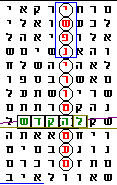
Evidence it's Real in Bible Codes?
See what may be a confirmation of the Shroud in the Bible Codes here |