|
|||
|
Is this the holy
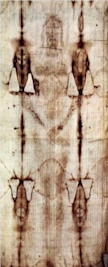
face of Jesus Christ? The Shroud of Turin
|
|||
|
The "Holy Face" of Christ photographed
by a blast of divine light?
|
|||
Since the Middle Ages, the most venerated relic of Rome and St.
Peter's Basilica is the so-called “Veil of Veronica”.
|
|||
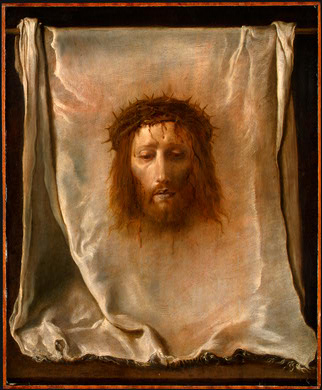
| According to the legend, Veronica was a pious woman
from Jerusalem who encountered Christ on His way to Calvary. Deeply moved by His
suffering, looking into His face pouring with sweat and blood, she wiped it with
her veil - and found His portrait imprinted on the cloth when she got it
back. The white, almost transparent veil measures about 6.5 by 9.5 inches and bears dark red features of a bearded man with long
hair and open eyes. The face on the veil is that
of a young man who has suffered greatly. He looks tired. The marks of blows that
have struck him are clear: bruises and other scars on the forehead, clotted
blood on his nose, one pupil slightly dilated. Yet, in spite of the evident
signs of suffering and pain, the look is that of a serene man enduring his
suffering with patience. The legend continues claiming that Veronica later traveled to Rome to present her “Holy Image” to the Roman Emperor Tiberius, healing him from some severe illness. The story of Veronica and her veil does not, in fact, occur in the Bible, though the apocryphal "Acts of Pilate" gives this name to the woman with a blood flow who was cured by touching the hem of Jesus' cloak. Matthew 9:20-22 & Mark 5:25-34 also report of this. Also, see how Jesus' fulfillment of this is a fulfillment of the Prophet Malachi's awesome Prophecy of the Tzit-Tzit: here Critics of the incidents historicity point to
the very name of the saint: "Veronica" is a combination of Latin and Greek words
meaning "true image." Nonetheless, the story has been a part of popular
Christian culture for centuries. As early as the 300s, there were documents,
which spoke of the existence of the veil, but only in the Middle Ages was it
strictly connected to the Passion of Jesus Christ. Catholics have honored this
tradition in their 6th Station of the Cross. When the part of the Basilica containing the relic
was scheduled to be taken down for remodeling, the relic disappeared overnight.
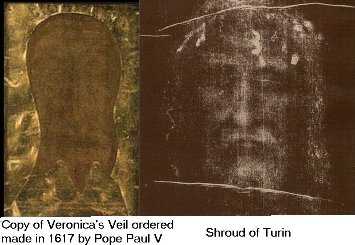
In 1616, Pope Paul V prohibited copies of Veronica's veil not made by a canon
of St. Peter's Basilica. Next, Urban VIII (Pope
from 1623 to 1644) not only prohibited reproductions of Veronica's veil, but
also ordered all existing copies to be destroyed. These actions suggest that the precious relic wasn't in the Vatican
anymore. Almost four centuries after the mysterious disappearance from the Vatican of the legendary veil of Veronica - with which Jesus is said to have wiped his face on the road to Calvary - German Jesuit Fr Heinrich Pfeiffer claims to have rediscovered it. Fr Pfeiffer, a professor of Christian Art History at the Pontifical Gregorian University, says he found the relic in the Abbey of Monoppello, Italy, high in the Apennine Mountains.
SHROUD OF TURIN CONNECTION WITH THE "Sudarium of Oviedo"
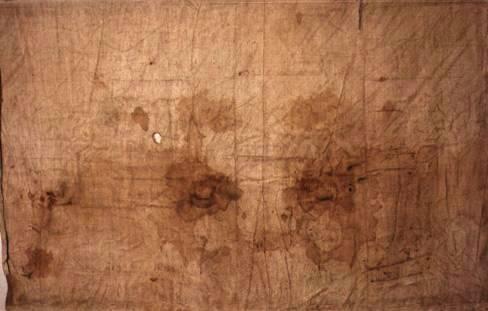
In the northern Spanish city of Oviedo, in a small chapel attached to the city's cathedral, there is a small bloodstained dishcloth size piece of linen that some believe is one of the burial cloths mentioned in John's Gospel. Tradition has it that this cloth, commonly known as the Sudarium of Oviedo, was used to cover Jesus' bloodied face following his death on the cross. Numerous historic documents tell us that the Sudarium has been in Oviedo since the 8th century and in Spain since the 7th century. It seems, too, to have arrived from Jerusalem. Documents from the late Roman period and the early Middle Ages are often sketchy and prone to chronological mistakes, and those pertaining to the Sudarium are no exception. But from a multiplicity of sources, scholars have extracted core elements of historical certainty and plausibility sufficient for a fair degree of historical reconstruction. We can be quite sure that the Sudarium came to Oviedo from Jerusalem, and there is some evidence it dates back to the 1st century CE. Its journey to its present location began in 644 CE. when Persians under Chosroes II invaded Jerusalem. To protect the Sudarium, it was moved out of the city to safety. We are uncertain of its route to Spain. It may have been first taken to Alexandria along with numerous other relics (real or otherwise, and stored in a chest or "ark") and from there, in succeeding years, along the coast of North Africa ahead of advancing armies. Such a cloth is known to have existed from the gospel of John, chapter 20, verses 6 and 7. These verses read as follows, "Simon Peter, following him, also came up, went into the tomb, saw the linen cloth lying on the ground, and also the cloth that had been over his head; this was not with the linen cloth but rolled up in a place by itself." John clearly differentiates between this smaller face cloth, the sudarium, and the larger linen that had wrapped the body.
Finish reading about the Sudarium here: http://www.shroudstory.com/faq-sudarium.htm Also read: The Sudarium of Oviedo: Its History and Relationship to the Shroud of Turin
November 2009 UPDATE
New mysteries of the Shroud unveiled
Finish reading this at:
World Net Daily |
|||